Thursday, January 30, 2014

Consider the Aga

The Aga is a much-desired British kitchen appliance for the affluent.  It's a heavy cast iron gas cooker (i.e., “stove” in American) with ovens and cook-plates; it stays on constantly during the colder months of the English fall/winter, keeping the kitchen warm and toasty.  We have one here at Spencer House, and I am considering it a lot recently since our conventional oven conked out on us Sunday night (and now it appears we’ll need an entire replacement). So, I’ll be cooking more on the Aga.


Spencer House Aga
The boiling plate open; simmering plate closed


Hotter oven open; bottom oven closed
So far I’ve fried sausage and bacon (the English kind – not real crispy) on top of the Aga.  I learned quickly that the left top burner gets a lot hotter than the right one.  Turns out the left burner is the boiling plate and the right one is the simmering plate.  The other day I also decided to try my hand at boiling spaghetti on the Aga.  To speed things up, I heated up my water in another British kitchen staple: the electric kettle.  Boy, these things really do the trick.  I might have to get one when I get back home…
  
  Philips HD4644/60 Cordless Kettle - White Master Image
Typical English Electric Kettle

Anyway, getting back to the prestige of the Aga – they are quite pricey.  For our version, a 2-oven/2-top plate cooker, folks in England will need to shell out about 4995GBP (that’s about $8215 USD).  $8000 for a stove, you say!  Well, it’s even more if you try to buy one in the US – you’re probably looking at $12,000 and up!  I see on the Aga website that Harvey Lumber Co. in Columbus used to be a non-servicing Aga dealer (are they still? are they still there?).  There’s also a dealer – Inscape Design Studio – in Americus!  Maybe Jimmy (in Plains) has one in his kitchen.


Friday, January 24, 2014

An Afternoon at the Ashmolean


On a recent dreary Thursday afternoon I took myself to the Ashmolean for a Tea-Time Tour entitled “Caskets and Cofers.”  On my last visit to Oxford in 2011, I had done a number of these free museum tours; they were always very focused and led by a museum employee who had in-depth knowledge of his/her subject .  I always enjoyed them.

I arrived early because you have to stand in line for a ticket.  Once I was left out of a tour because I showed up too late. This time I wanted to be early.  The tour was scheduled from 3:45 to 4:30, but when I arrived at the Ashmolean it was only going on 3.  Wandering around the basement area, trying to decide if I wanted to spend a few minutes with a Diet Coke, I saw a sign announcing a harpsichord concert at 3. So, I scurried off to find it!


I arrived at the concert space in plenty of time.  The old harpsichord was set up in front of a small audience.  It was a little after three when the event finally began.  The harpsichordist, a middle-aged thin man with longish grey hair and a tweedy jacket, was planning to play a few pieces, but I had decided I would only stay to hear the first: a Scarlatti Sonata.  I got excited at first because I thought it might be something I would recognize from my past (twelve years of taking lessons from Lakeview’s most famous piano teacher: Vernile Winn – always loved that name).  Wrong; I don’t think I’d ever heard this one.  The piece I had wanted to hear was actually one of my old favorites: Clementi’s Sonatina in C Major.  Click here to hear that one: Clementi Sonatina -- on a piano, not a harpsichord.

Anyway, after the first piece I left and headed for the tour waiting area in the Greek and Roman Sculpture Gallery.  I got there about 3:20 and no one was sitting on any of the benches.  Eventually an elderly (i.e., older than me!) sat down at the end of my bench.  I asked him if he were waiting for the tour, but he said, “No.”  Then just before 3:45, the tour guide arrived.  We chatted for a moment, and she said of course she would do the tour for just one person.  Yay!

As my guide explained, she had picked out some interesting boxes that are featured in various Ashmolean collections.  We started out with a coffin from Knossos.  It was a very interesting container, with some slight decoration on it – not long enough for a body to be laid down inside (the guide said they merely bent the body over).


We next looked at a large pot with an octopus painted on it – this octopus only had six tentacles.  It was very fanciful.  There are a lot of maritime symbols on the pottery from Knossos.


At this point another person joined our tour – so I wouldn’t be getting the guide’s undivided attention.  No biggie.  The other person must have been an art student; she asked lots of good questions and made interesting comments. I was glad she joined us!

I won’t talk about each piece we saw, but I will give you a link to the Ashmolean’s pages for three of my favorites:  an Indian mother-of-pearl box, an Indian leather and mixed media box and a French (Limoges) reliquary casket for St. Thomas Becket. Just click below on the blue text for a picture and more info on each item.

This box dates from the early 17th Century.  Each sliver of pearl is attached with a little silver peg.

Shagreen is leather that was made by laying little pebbles on top of a piece of damp leather -- then walking on them.  When the leather dries, the pebbles are shaken off, and they leave tiny little pock marks on the underside of the leather.

Made in Limoges around 1200AD.  The blue is enamel -- made by in-laying powered colored glass and melting it.  This cofer may have contained a bone of St. Thomas Becket or an article that he had worn or something that had come in contact with him.


Tuesday, January 21, 2014

Hooked on British TV Food Shows


Well, now that I’m in Oxford, I’m settling into my routine, which involves a nightly dose of British TV.  I have to say these guys present some really interesting topics.  In the last week I’ve watched the history of the bathroom (starting with medieval public baths and toilets), the “Who Do You Think You Are” story of David Suchet (a.k.a. Hercule Poirot), an episode of my favorite detective series: “Midsomer Murders” (with the new Barnaby), and a documentary on the disappearance of the English Lawn (which included a history of lawn mowers). 

But, of course, being a foodie (love to cook--and eat!), the food programs draw me in the most.  I started out by watching Nigel Slater expound on the love Brits have for their biscuits – learned about all the various cookies from Garibaldis to HobNobs to Wagon Wheels (shown top to bottom):


"Come Dine with Me" diners from the fishing town of Grimsby


Next, I got sucked into “Come Dine With Me,” where four or five people (strangers to one another) come together to entertain and cook a meal.  Each person cooks a  meal  one night and then the others score him/her.  The series, when shown as a  marathon,goes on for 4 or 5 hours.  One day I watched 5 hours worth in one sitting!  Very entertaining.  Diners are very critical -- and funny!


But my favorite program so far is “Britain’s Best Bakery.”  Every week three bakeries from a certain section of the country compete against each other.  One night there was an Oxford bakery, Gatineau, which is in nearby Summertown.  Sadly, they lost.  It’s an hour-long show, and I love seeing the unusual techniques and ingredients they use.  Some of the teams forage – they go out and find herbs or other ingredients along the roadside.  Tonight the winning team, from the Baker's Table in Wales, was new to the field of baking – one of them was formerly an archaeologist!  Anyway, they made a homey ginger and walnut cake, a bread that had pesto on top (kinda like a pizza) and a cream puff filled with apple custard and whipped cream.  All this makes me very hungry!


Tonight’s winning bakery:  The Baker’s Table

So, I think I’ll go heat up my left-over “Curry in a Hurry” – made from a recipe I saw on a Nigella Lawson show.  Quite good, actually!  Cheerio!


Monday, June 20, 2011

Duke Humphries Library

I thought it would be appropriate to end my Oxford blog with something more serious -- something I am very passionate about:  libraries!  One of the major perks for serving as the Columbus State Oxford site coordinator was that I got a Bodleian Library card.  This is a big deal, as it gets me into Oxford libraries and into special places like Magdalen College Garden and Christ Church "Big Tom" entrance without a fee.  It also allows me to access all of the University of Oxford's fabulous electronic resources -- from the privacy of my room at Spencer House.

Needless to say, during my six-month sojourn in Oxford I have been very distracted with a bit of sight-seeing, visits from U.S. friends, trips to London to see Tiff, Midsomer Murders on TV (ha!), etc.  I have not done as much library research as I thought I would do.

There are 3 major things I am researching:  the Wren family (mine), the Spencer family (not mine) and Basil Hall, the Scottish travel writer who came to Columbus before the lots were sold in 1828 (for a Muscogiana article).  The two genealogical projects have waned a bit because I still don't know were the English Wrens and Spencers were from inside the country.

However, a week or so ago, I did wander over to the Bodleian's Special Collections Room (temporarily housed in the Radcliffe Science Library) and managed to look at a 1685 manuscript about the Spencers of Yarnton that was compiled by a man named Anthony a Wood.  Apparently he was a seventeenth century genealogist/antiquarian.  It was a big deal for me to see this manuscript because my Bodleian card wasn't coded for manuscript access, but the nice people at the desk got permission for me to view it.

They also helped me order 3 Basil Hall items that were in storage.  It took about 24 hours to get them retrieved, and they were delivered to the Duke Humphries Library inside the old Bodleian Library for me to use.  Basically, this is the oldest part of the Bodleian -- dating back to the 15th century.
When I went to Duke Humphries the first time, I had a problem getting in.  They wouldn't let me bring my purse in, but they didn't provide lockers so that I could lock it up.  Dumb.  So, I had to wait till the next day.  On that day, I stopped by the Radcliffe Science Library, put my purse in a locked locker, and strolled down to the Bodleian with just a few pieces of paper and a pencil.

Reading in Duke Humphries was quite an experience.  The library is a long hall, with short book stacks jutting out from each side of the the windows that line the side walls of the hall.  This arrangement creates little alcoves.  In each alcove there are desks and above them are shelves of old books.  In the early days, these books were chained to the shelves.  Lighting is not the best; in the old days, the windows provided the only light.  You better not light a candle in the library!

Unfortunately, since cameras aren't allowed in Duke Humprhies, I couldn't take any photos.  However, if you'd like to see one and read a bit more, go to
http://en.wikipedia.org/wiki/Duke_Humfrey%E2%80%99s_Library

I looked at 3 items.  One was a review of Basil Hall's Travels in North America, 1827-1828, which contains a brief description of Columbus on April 1, 1828, as it was being surveyed in preparation for the sale of lots.  According to Hall, there were about 900 people on the site, building make-shift houses that they could roll on logs to the lot that they finally purchased, and milling about trying to earn a buck (the carpenters and blacksmiths).  There were also a number of lawyers on the scene -- ready to help folks with their land transactions.  Anyhoo, the review (written in 1829) was by an American who accused Hall of feeding the ill-will that had brewed between the Americans and the English since the end of the Revolution.  Interesting, but...

A second item was a pamphlet on the Camera Lucida, a devise that aided in drawing.  Hall used a Camera Lucida to sketch pictures of Columbus and the other places he visited on his 1827-1828 journey.  In fact, Hall became a major spokesperson for the device.  The pamphlet contains a letter written by Hall explaining how to use the Camera Lucida.

The final item is a book of 40 of the sketches that Hall made on his trip.  These are etchings that were made from the sketches. In all, Hall made about 169 sketches, which are now owned by the Lily Library at the University of Indiana.  The famous sketch of "Columbus, an embryo town" is in the book, which was published in 1829, and is now out of copyright.  I looked into having the Bodleian make a scan of the sketch so that we could use it in Muscogiana.  It was going to be around $50.  However, when I was searching the web later that day, I discovered that the Alabama Department of Archives and History has the same book, and they can make a scan for $15.  Much better deal!

So, I know this is more than you ever wanted to know about Duke Humphries or my research projects, but these are some of the things that make me happy -- nerd that I am!

That's probably it for the Oxford Omnibus.  I'm headed home soon and will probably not have time to do additional postings.  I've enjoyed sharing my Oxford experience with you all -- thanks for reading!  I hope you've found it entertaining and enlightening! 

Cheers, Callie

Saturday, June 18, 2011

Dalston Market


Whilst (to use a British term!) visiting Tiff in London, we made a few trips to Dalston Market, which is just up the street from Tiff's flat.  Unlike Oxford's basic "white bread" Glouster Green, this market features a lot more diverse vendors and customers.  It's mainly a food market, with the food taste catering to people from all over the globe.

Thought you might enjoy a few pictures:


Cow's stomach -- yum!

The blue fish (natural color) is a Parrot Fish.


Cow's feet -- 2 for 2.50 GBP

The Brits don't refigerate their eggs in the stores; most are free-range

Whole chickens -- with heads!


Thursday, June 16, 2011

Glouster Green Market

Every Thursday in Oxford there's a market in Glouster Green.  It's at the market square located off George Street near the bus station and runs from about 8am to 3 or 4pm, with vendors selling antiques/junque. rugs, books, food, clothes -- a little of everything.  In all there are probably about 50 stalls, most crowded with stuff to look through.  The prices are good too!  Today I bought another Inspector Morse paperback for a pound.  Also enjoyed a lamb wrap for a mere 2.69!

Scenes from Glouster Green Market --


Monday, June 13, 2011

Abney Park Cemetery


Back in April, on a visit with Tiff in London, we ventured up Kingsland Road to Stoke Newington.  It’s much more artsy and Bohemian than Tiff’s Dalston neighborhood.  What I recently discovered is that beginning in the eighteenth-century, it was a haven for non-conformists (i.e., people whose religion was NOT Church of England – Methodists, Baptists, Quakers, and the like).  There was even a college there called the Dissenting Academy for young men who were denied entrance to Oxford and Cambridge because they were not members of the Church of England.  English novelist Daniel Defoe, also a dissenter, was born and lived in Stoke Newington.  BTW, Edgar Allan Poe, though not a dissenter, also lived in Stoke Newington; he attended Manor House school there from age 8 to 11 -- 1817-1820 ( I was totally unaware of Poe's British connections).
Walking down one of Stoke Newington’s crowded streets, I noticed an interesting-looking cemetery.  Actually, I couldn’t see much of the cemetery – just a sign and the huge Egyptian revival entrance gates.  Tiff’s friend Tony, who was with us that day, affirmed that it was an old cemetery and that we should check it out after we got a bit to eat and checked out the farmers’ market.  Nowadays, Stoke Newington is also a haven for organic foodies!
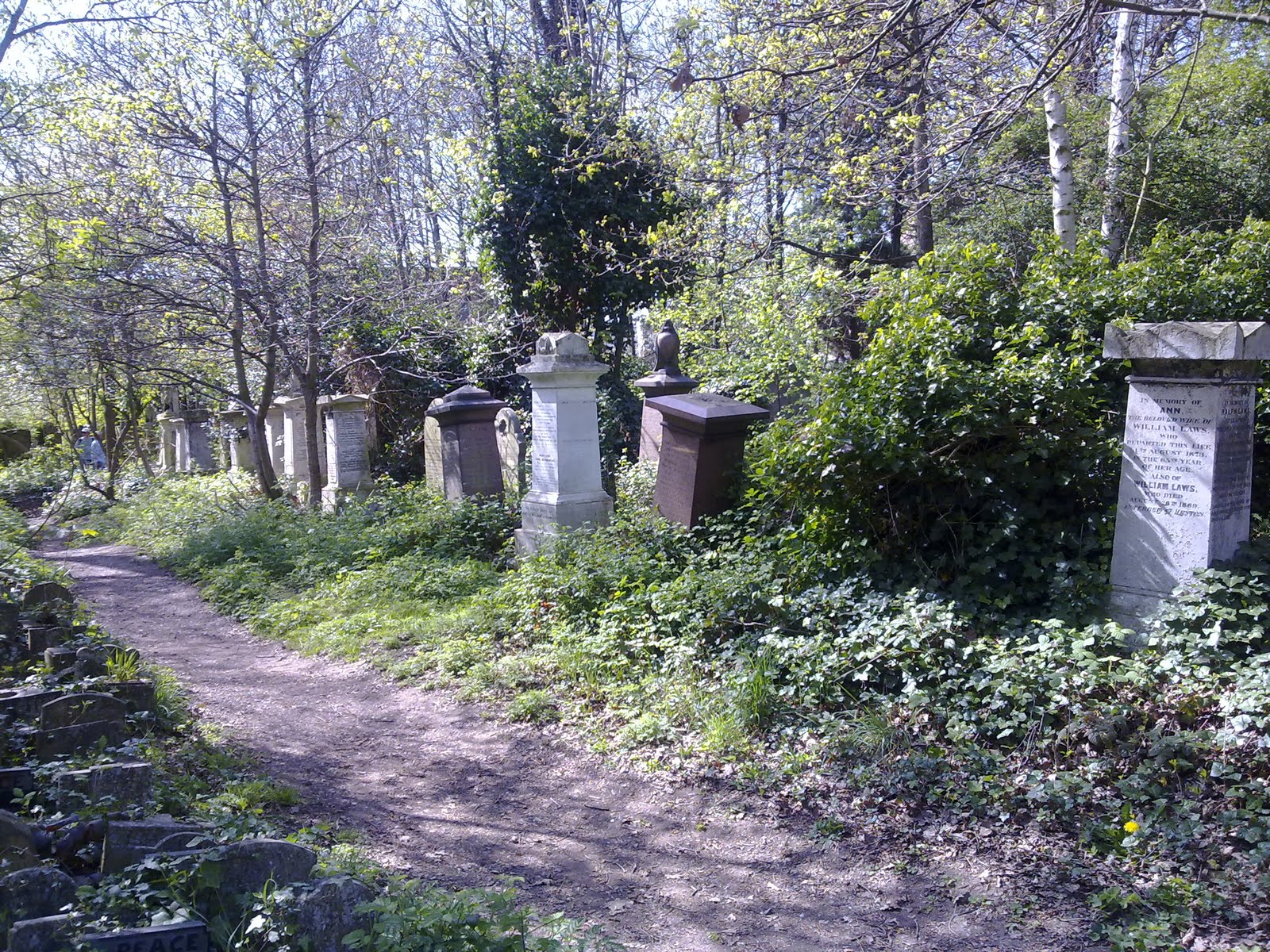
So, that’s what we did:  we entered the gates of Abney Park Cemetery.  It was founded in 1840 as a privately-owned garden-style cemetery, based on the Mount Auburn model in Massachusetts.   Being in Stoke Newington, it was also a cemetery for non-conformists.  It was very well-planned by landscape designers, and initially it contained a rose garden and an arboretum, with trees in A to Z order surrounding the edge of the 32-acre cemetery.

Among the people buried there are William Booth, who founded the Salvation Army (sorry, no picture of his grave).  Another non-conformist interred at Abney Park was Henry Richard, a Welshman, known as “The Apostle of Peace,” an anti-war protestor and promoter of religious freedom.

Isaac Watt, “The Father of English Hymnody,” while not buried in the cemetery, did live at Abney House, the estate upon which the cemetery was built.  There is a large statue of him in the cemetery.  Two of Watts’s best-known hymns are “Oh God, Our Help in Ages Past” and “When I Survey the Wondrous Cross.”
Nearby Watts’s statue is the cemetery’s Gothic church, which was built specifically for non-denominational services.  Unfortunately it was pretty much destroyed by fire in the 1970s, but you can still peek in the ruins.


Today, the Abney Park Cemetery is owned by a trust that is maintaining it as a cemetery and a park.  The graves are in major disrepair, but it is a wonderful green space in the heart of a well-populated London suburb.  The day we visited there were a lot of people, walking their dogs, taking photos, admiring the gravestones, reading the newspaper...


The Bostock family was into wild animals -- they apparently brought African and Asian live specimens to London for people to see. 

It is charming and magical; many videos are shot there – including Amy Winehouse’s  “Back to Black” (http://www.youtube.com/watch?v=w1evzhSast8), in which you get a few glimpses of some graves and the Gothic chapel.   It is also a venue for cultural, artistic and musical events.  Next month, on July 2, there’s a Blues/Folk Festival in the cemetery.  Cool! 

For more information about Abney Park Cemetery see
http://www.abney-park.org.uk/Abney_Park_Trust_website/Welcome.html

Photos by Tiff -- taken on her Iphone.